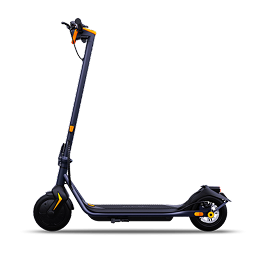
Seven models. One of them is yours.
The question is not "which is the best Wispeed scooter?". The right question is: which model fits my journey, my terrain and my constraints?
An AIRO V6 is perfect for 4 km of flat cycle lane and three flights of stairs. It will be miserable on the hills of an undulating city. Conversely, a SUVPILOT 480 R will swallow any gradient — but its 32 kg can be a drawback.
This guide starts with how you ride, not with a spec sheet. Ten minutes of reading, and you will know which one to order.
The full range at a glance
| Model | Range | Motor | Gradient | Weight | Wheels | Brakes |
|---|---|---|---|---|---|---|
| AIRO V6 | 20 km | 350 W / 540 W | 12% | 15.5 kg | 8.5" | Rear disc |
| AIRO V10 | 40 km | 400 W / 700 W | 14% | 19.65 kg | 10" | Rear disc |
| AIRO V16 | 60 km | 400 W / 700 W | 14% | 20.5 kg | 10" | Rear disc |
| SUVPILOT 150 R | 60 km | 500 W / 800 W | 20% | 30 kg | 10" off-road | Front + rear drum |
| SUVPILOT 480 R | 65 km | 500 W / 900 W | 25% | 32 kg | 10" off-road | Front + rear disc |
| WIMOB SCOOT L1e-B light moped |
40 km | 350 W | 14% | 27 kg | 14" semi off-road | Front + rear disc |
| WIMOB PLUS L1e-B light moped |
45 km | 250 W / 350 W | 14% | 32.5 kg | 20" semi off-road | Front + rear disc |
| WIKIDS Children |
5 km | 100 W | — | 11 kg | 14" | Rear drum |
Every adult model is limited to 25 km/h, road-legal, and fitted with lights, indicators, six reflectors and a lock. The WIKIDS is capped at 8 km/h: it is a balance bike for learning, nothing more.
First question: scooter or balance bike?
This is the structural choice, and it has nothing to do with budget.
The e-scooter — standing, folding, compact
Our AIRO and SUVPILOT ranges are personal light electric vehicles. You ride standing, the scooter folds, it slides into a boot or under a desk. This is the choice for mixed journeys: a few kilometres, then the metro, then the lift.
The electric balance bike — seated, L1e-B approved
Our WIMOB models are light mopeds, type-approved in category L1e-B. You ride seated, on a saddle, with a kickstand. No licence and no registration document are required — but third-party liability insurance is compulsory, exactly as it is for a scooter.
They do not fold. They weigh between 27 and 32.5 kg. In exchange: a seated riding position, 14- or 20-inch wheels, and a level of comfort no scooter can match over distance.
The one-sentence test: will you have to carry your vehicle, even once a day? If yes, take a scooter. If it goes from the garage to the street and back again, the balance bike is far more comfortable.
2026 regulations: what the law says about e-scooters and light mopeds →
Second question: how much range do you actually need?
Unlike many brands that advertise figures you will never reach, the ranges quoted on Wispeed models are realistic and reflect ordinary daily use.
They will of course vary with rider weight, terrain, outside temperature and riding style — but they are not deliberately inflated.
How to choose: simply allow yourself a comfortable margin, so you can space out charges and protect your battery over the long term.
In practice, for a daily round trip of:
- Under 6 km → the AIRO V6 (20 km quoted) is more than enough.
- 6 to 12 km → look at the AIRO V10 (40 km) or the WIMOB SCOOT (40 km).
- 12 to 20 km → AIRO V16 (60 km), SUVPILOT 150 R (60 km) or WIMOB PLUS (45 km).
- Over 20 km, or suburban riding → SUVPILOT 480 R (65 km), the longest-legged in the range.
One detail that matters: charging time ranges from 6 hours on the V6 to 10–11 hours on the V10 and V16. If you charge overnight, no problem. If you plan to ride in each morning and recharge at the office before riding home, look at that figure carefully.
Third question: are there hills?
A useful reminder: all our scooters are limited to 25 km/h. A more powerful motor will not make you go faster. It will make you climb.
So it is the "maximum gradient" figure that should guide you — not the watts:
- 12% (AIRO V6) — a flat city, gentle inclines. Beyond that, it runs out of breath.
- 14% (AIRO V10, V16, WIMOB) — ordinary urban hills, bridges, car-park ramps.
- 20% (SUVPILOT 150 R) — a hilly city, serious climbs every day.
- 25% (SUVPILOT 480 R) — nothing stops you. It is also the only model with a 48 V battery.
Maximum rider weight is 100 kg on the AIRO V6, the WIMOB SCOOT and the WIMOB PLUS, and 120 kg on the V10, the V16 and both SUVPILOTs. Check that figure before anything else.
Fourth question: will you be carrying it?
Weight is never felt while riding. It is felt on the metro stairs, at the boot of the car, on the third floor without a lift.
Our range runs from 15.5 kg to 32.5 kg.
- AIRO V6, 15.5 kg: carries comfortably in one hand over a hundred metres.
- AIRO V10 and V16, around 20 kg: carryable, but not for long.
- SUVPILOT, 30 to 32 kg: they fold, but taking one up a staircase is another matter.
- WIMOB, non-folding: they park on their kickstand.
Fifth question: riding in the rain?
The five AIRO and SUVPILOT scooters are rated IP65. The WIMOB models are rated IPX4 to IPX5.
Let us be clear about what that means: these ratings protect against splashes and passing showers. No electric scooter is designed to be submerged, to cross a deep puddle, or to be cleaned with a hose. Water remains the leading cause of electronic failure, and immersion damage is not covered by the warranty.
After riding in the rain: wipe it down, let it dry, then charge it.
What to do if your scooter will not start after the rain →
Our ranges, model by model
AIRO series — the city, simply
Three models, one logical progression: the higher you go, the further you ride and the more comfortable you are.
AIRO V6
20 km, 15.5 kg, 8.5" wheels, front suspension, rear disc brake, 12% gradient.
For whom: short trips, flat city, a rider who has to carry the scooter. The lightest in the range.
AIRO V10
40 km, 19.65 kg, 10" wheels, dual suspension, rear disc brake, 14% gradient, 120 kg load.
For whom: the daily commute. It combines dual suspension, effective braking and comfortable range for everyday use.
AIRO V16
60 km, 20.5 kg, 10" wheels, dual suspension, rear disc brake, 14% gradient, 120 kg load.
For whom: those who want to forget the charger. Three times the range of the V6 for €110 more. Note that it shares the same specification as the V10; its advantage is the 60 km range, for riders who want to charge less often.
SUVPILOT series — when the city isn't flat
SUVPILOT 150 R
60 km, 30 kg, 10" off-road tyres, adjustable dual suspension, front and rear drum brakes, 20% gradient, 20 cm deck.
For whom: hilly cities, tracks, cobblestones. Drum brakes, shielded from spray, need very little maintenance — a real advantage off the tarmac.
SUVPILOT 480 R
65 km, 32 kg, 10" off-road tyres, adjustable dual suspension, front and rear disc brakes, 25% gradient, 48 V / 18 Ah battery, 500 W / 900 W motor.
For whom: the flagship of the scooter range. The only model with a 48 V battery, the only one that climbs 25%. If you face serious hills every day, nothing else in the range will last.
See the full SUVPILOT series →
WIMOB series — the road-legal balance bike
WIMOB SCOOT
40 km, 27 kg, 14" semi off-road wheels, adjustable front suspension, front and rear disc brakes, kickstand, 7.4" display, brake-lock anti-theft.
For whom: mini-moto looks in a compact format. Lighter and more agile than the PLUS, with mirrors and a horn.
WIMOB PLUS
45 km, 32.5 kg, 20" semi off-road wheels, adjustable front suspension, front and rear disc brakes, kickstand, 7.4" display.
For whom: scrambler styling and maximum comfort. Its 20-inch wheels clear obstacles no scooter can, and settle the ride over long distances.
WIKIDS — the first balance bike
WIKIDS
Two progressive speeds (6 then 8 km/h), 5 km range, 11 kg, 14" pneumatic tyres, drum brake, 50 kg maximum load, 24 stickers included.
This is not a miniature scooter: it is a balance bike for learning. With no pedals, it helps a child find their balance, with gentle assistance. "Tortoise" mode at 6 km/h to begin, "hare" mode at 8 km/h once the confidence is there.
Where to use it: garden, courtyard, park paths, under adult supervision. Not on the road. And children must wear a helmet.
Four riders, four answers
"I ride 5 km a day and I climb three flights of stairs"
AIRO V6. At 15.5 kg, you can carry it. Twenty kilometres of range covers several days of commuting. No point paying for a battery you will never empty.
"Daily commute, ordinary city"
AIRO V10 or AIRO V16. Dual suspension, rear disc brake, 40 to 60 km of range, 120 kg maximum load. These are the models that tick the most boxes for the money.
"My city is hilly, and I ride every day"
SUVPILOT 150 R if 20% gradient is enough, otherwise the SUVPILOT 480 R if the hills are genuinely steep.
"I want comfort, and I never carry my vehicle"
WIMOB SCOOT for agility, WIMOB PLUS for the sheer comfort of 20-inch wheels. Seated, road-legal, no licence and no registration document.
The criterion nobody mentions: spare parts
An electric scooter is made of consumables. Tyres wear out, brake pads wear out, levers snap, chargers fail, batteries age. That is not a hypothesis, it is a certainty.
So the real question becomes: in three years' time, will you still be able to find the part?
A cheap scooter whose brand has vanished becomes waste at the first serious fault. That is why we distribute our own original spare parts, why our products carry a two-year warranty, and why we guarantee spare-part availability for seven years. A commitment that lets you repair your vehicle, and extend its life long after you bought it.
Browse the spare parts catalogue →
What you must do before you ride
Two obligations, applying to every adult model, scooters and balance bikes alike:
- Take out third-party liability insurance. A personal light electric vehicle or a light moped is legally a motor vehicle: liability cover is compulsory, even limited to 25 km/h. Check your home insurance policy first — it usually excludes motor vehicles.
- Check your local rules. The national framework is clear, but a local authority can close certain streets, require a helmet, or restrict parking.
Our complete guide to the 2026 regulations →
Frequently asked questions
Which Wispeed scooter should I use to commute?
The AIRO V10 or the AIRO V16 in most cases: up to 60 km of quoted range, dual suspension, rear disc brake. If your city is flat and you carry your scooter, choose the V6. If it is hilly, move up to a SUVPILOT.
What is the difference between a scooter and a WIMOB balance bike?
The scooter is a personal light electric vehicle: you ride standing, it folds. The WIMOB is a light moped type-approved in category L1e-B: you ride seated, it does not fold. Neither requires a licence or a registration document, and both require liability insurance.
Do I need a licence for a WIMOB?
No. Neither a car licence nor a moped licence. That is the key difference from a moped or a 45 km/h speed bike.
What range should I really expect?
The ranges quoted by Wispeed are measured under realistic conditions and generally correspond to ordinary daily use. As with any electric vehicle, they vary with rider weight, terrain, weather and riding mode.
Can I ride in the rain?
In damp weather and passing showers, yes. In heavy rain, through puddles, or submerged, no — whatever the IP rating. Braking distances also lengthen considerably.
Which scooter suits a rider over 100 kg?
Look at the maximum load: 120 kg on the AIRO V10, the AIRO V16 and both SUVPILOTs. The AIRO V6 and the WIMOB models are limited to 100 kg.
In summary
Start with your journey, never with the spec sheet. Choose a range suited to your daily use, keeping a comfortable margin so you charge less often. Choose power according to your hills, not your speed — every model is limited to 25 km/h. Weigh the scooter if you have to carry it. And check the maximum load before anything else.
If you are still torn between two models, describe your journey to us: distance, gradient, road surface, stairs. We will tell you which one, and why.
See the scooters See the balance bikes Ask for advice
Updated July 2026. Ranges, gradients and load limits are those of the manufacturer's technical specifications, measured under optimal conditions. Real-world performance varies with rider weight, terrain, temperature and riding style.